As Burna Boy, Shakira Release FIFA World Cup Song
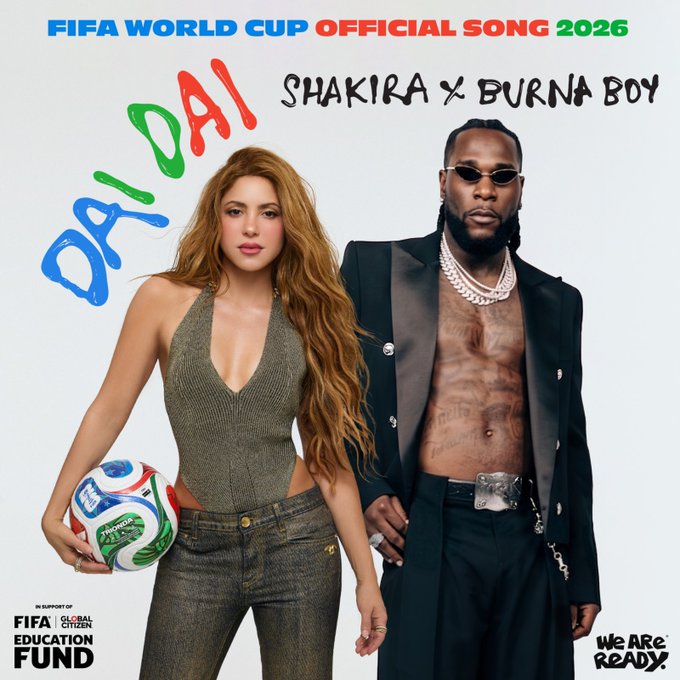
As Burna Boy collaborates with Shakira on “Dai Dai,” the official song of the 2026 FIFA World Cup, it is yet another global win for Nigerian music.
Before this, Davido performed “Hayya Hayya (Better Together)” during the 2022 FIFA World Cup in Qatar. Burna Boy also headlined the UEFA Champions League Final Kick-Off Show in 2023. Nigerian stars like Wizkid, Tems, Tiwa Savage and others have appeared on some of the world’s biggest stages, festivals, award shows and collaborations with global stars.
Nigerian Music Was Seen as Second-Rate
As a child, I never imagined Nigerians would one day dominate global music conversations like this.
Back then, the biggest stages belonged to America, the UK, Canada and, if reggae or dancehall was needed, Jamaica.
Michael Jackson, Lionel Richie and Madonna were the global stars. Even when one of ours like Sade Adu stood on the world stage, she was presented through the UK.
We loved Nigerian musicians, but we still called them “local,” with that subtle suggestion of being second-class. Western musicians were the “international artists.”
At parties, Western music dominated. If you requested Nigerian songs, someone might call you “bush.”
Our biggest concerts – from Golden Tones to Star Mega Jam – were incomplete without a foreign headliner.
Yet Nigeria already had legends: Fela Kuti, Sonny Okosuns, Majek Fashek, Onyeka Onwenu and many others.
From the 1980s, Bright Chimezie sang about colonial mentality, lamenting how Nigerians looked down on Nigerian music, culture, language. From the mid 1990s, Dr. Raymond Dokpesi pushed Nigerian music heavily on his Ray Power FM and Africa Independent Television. Kenny Ogungbe and Dayo Adeneye of Kennis Music championed Nigerian hip-hop. President Olusegun Obasanjo increased support for local content in broadcasting. Yet, it seemed as if it was water poured on the back of a duck.
Then Suddenly, Something Changed
On Saturday, May 15, 2004, amid heavy rain and flooding in Lagos, 2Baba (then known as Tuface Idibia) released Face 2 Face, featuring “African Queen.”
That album helped change Nigerian attitudes toward Nigerian music. “African Queen” was even used as the soundtrack for a Hollywood movie.
Finally, the years of planting seemed to be bearing fruit.
The interesting thing is that the artists behind Afrobeats created it with Nigerian rhythms, Nigerian expressions, Nigerian melodies and Nigerian identity. They created something rooted in us.
- Nigeria accepted it first.
- Africa embraced it next.
- Then the world came calling.
Today, the sound born from our streets, clubs, churches and campuses is played in stadiums across the world.
What we once dismissed as “local” has become global. And that may be one of the greatest cultural transformations Nigeria has ever produced.
Interestingly, it happened because Nigerians chose to embrace their identity and refine their voice rather than shrink or embrace a strange one.
- By Azuka Onwuka – @BrandAzuka on all platforms
\ Get the latest news /