
How Tantalus Gave Us “Tantalize,” “Tantalizing”
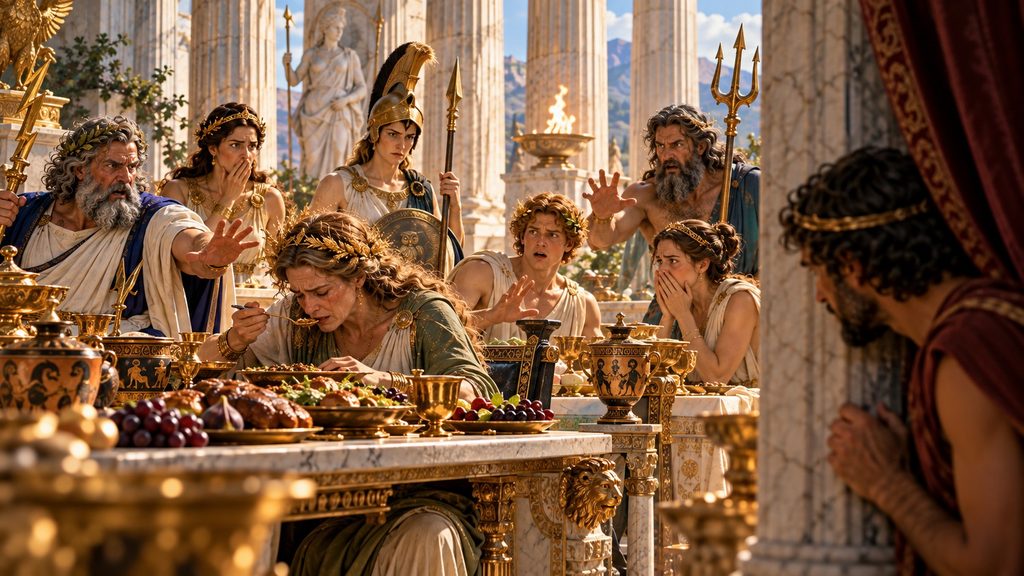
- Grief-stricken Demeter unknowingly eating the evil menu served by Tantalus
Imagine standing in a pool of cool, fresh water. You are desperately thirsty. The water reaches almost to your mouth. All you need to do is bend down and drink.
You lower your head. The water disappears. You straighten up. The water returns.
Above you hang branches heavy with delicious fruit. You are starving, and the fruit is so close that you can almost taste it.
You stretch out your hand. A wind suddenly lifts the branches beyond your reach. You withdraw your hand. The branches return. You try again. They move away again.
A classic case of water everywhere, but not a drop to drink. Food almost touching you, but not a morsel to eat. And this does not happen for an hour or a day. It happens forever.
Welcome to the punishment of Tantalus.
In Greek mythology, Tantalus was no ordinary mortal. He was a wealthy king and, in some traditions, a son of Zeus. As the king of the gods, Zeus treated him specially and the gods favoured him. Even more remarkably, he enjoyed a privilege few mortals could boast of: he was welcomed among the gods and the gods dined in his palace. But Tantalus abused that privilege. Exactly what he did varies among the ancient accounts.
One says he stole nectar and ambrosia from the gods and gave them to his mortal companions. These were the exclusive drink and food of the gods. Another says he revealed divine secrets that mortals were never supposed to know.
But there is a much more gruesome story. According to this version, Tantalus decided to test whether the gods were truly omniscient or all-knowing. He killed his own son, Pelops, cut up his body, cooked it and served it to the gods at a banquet.
The gods realized what Tantalus had done and refused to eat. Demeter, however, distracted by grief over the loss of her daughter Persephone, ate part of Pelops’s shoulder before discovering what had happened. The gods restored Pelops to life and replaced the missing shoulder with one made of ivory.
But Tantalus would pay dearly for his horrible offence. He was condemned to the Underworld, where he would spend eternity surrounded by the very things he desperately wanted but could never have.

- Tantalus in eternal punishment in the Underworld
When he was thirsty, water was right there but withdrew when he tried to drink. When he was hungry, fruit hung above him but moved away whenever he reached for it.
Just imagine the cruelty of that punishment.
Rather than being denied food and water, his torment was almost having them but losing them. Again. And again. And again.
Centuries later, the name Tantalus gave English a verb for exactly that experience:
tantalize.
To tantalize someone is to excite them with the sight, possibility or promise of something desirable while keeping it frustratingly beyond their reach.
That is why you might say:
The smell of freshly baked bread tantalized the hungry customers waiting outside.
Or:
The company has been tantalizing fans with hints about its new product without revealing it.
And when something looks extremely attractive or tempting, we call it tantalizing.
A tantalizing offer.
A tantalizing possibility.
A tantalizing glimpse.
So, the next time someone says something is tantalizing, picture an ancient king standing in water he cannot drink and beneath fruit he cannot eat. The thing he desperately wants is right there. Almost within reach. But never quite. His name was Tantalus.
And more than two thousand years later, his punishment still lives in the English language.
\ Get the latest news /